

Flat webbing is a type of woven textile strap characterized by its flat, ribbon-like construction. While tubular webbing is a type of woven textile strap constructed as a hollow tube, creating a fundamentally different structure from flat webbing. "Flat" or "tubular" is easily seen from just the appearance of the webbing, the two webbing have quite many in similar and a lot more to be different. How to choose a flat or tubular webbing for the right project?
There are some key similarities between flat and tubular webbing:
Material Composition
- Both are typically made from the same synthetic fibers (nylon, polyester, polypropylene, or aramid fibers like Kevlar)
- Use similar polymer chemistry and fiber properties
- Available in the same material grades and specifications
Manufacturing Process
- Both are produced using weaving techniques on industrial looms
- Similar quality control standards and testing procedures
- Comparable dyeing and finishing processes
Strength Characteristics
- Both achieve high tensile strength ratings
- Similar breaking strength when comparing equivalent materials and widths
- Comparable stretch characteristics under load
- Both maintain strength across temperature ranges
Performance Properties
- UV resistance depends on material choice, not construction type
- Chemical resistance is similar for the same base materials
- Both offer excellent strength-to-weight ratios
- Similar fatigue resistance under repeated loading
Applications
- Both suitable for load-bearing applications
- Used in climbing, rigging, and industrial applications
- Both can be sewn into slings, runners, and harnesses
- Compatible with the same hardware (carabiners, buckles, etc.)
Standards and Certifications
- Both can meet the same safety standards (CE, UIAA, ANSI)
- Subject to identical testing protocols for strength and safety
- Available with the same certifications for specific industries
Maintenance and Care
- Same cleaning and storage requirements
- Similar inspection criteria for wear and damage
- Comparable lifespan under normal use conditions
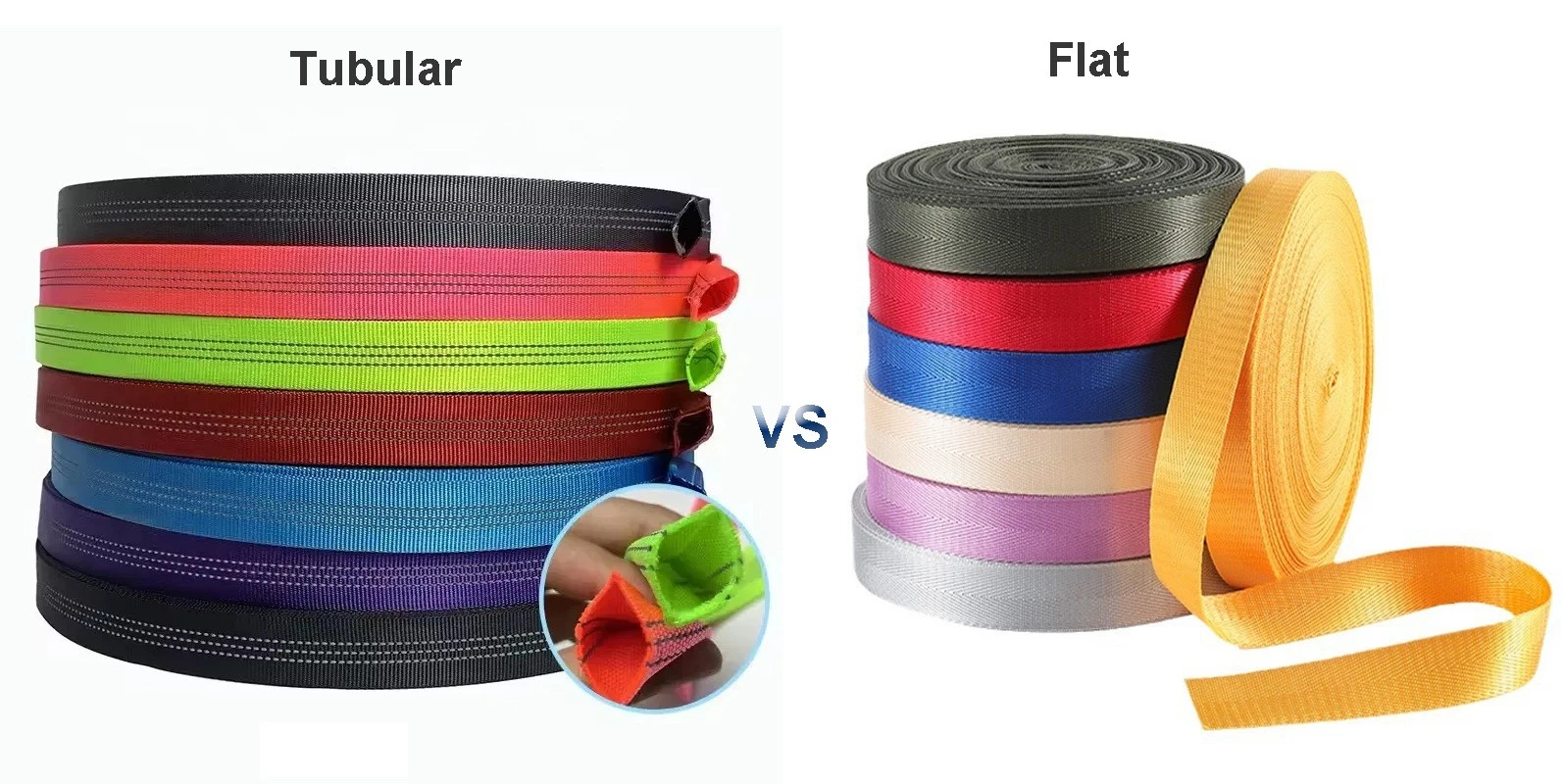
So, it's easily found that the fundamental material properties or capabilities of the two webbings are quite similar. However, there are still many differences between the two in terms of physical construction and performance. The differences lie in:
Construction
- Flat webbing: Woven as a single flat layer with a tight, dense weave pattern.
- Tubular webbing: Woven as a hollow tube, creating a circular cross-section when pressurized, also known as "double -layer" webbing.
Strength Distribution
- Flat webbing: Strength distributed evenly across the full width, generally stronger per unit width.
- Tubular webbing: Strength concentrated at the edges where the tube folds, can have slightly lower strength ratings for same width.
Handling and Feel
- Flat webbing: Stiffer, less comfortable against skin, can have sharp edges.
- Tubular webbing: Softer, more pliable, rounded edges that are gentler on hands and gear.
Abrasion Resistance
- Flat webbing: Superior abrasion resistance since wear is distributed across the entire surface.
- Tubular webbing: More susceptible to edge wear and can concentrate abrasion damage.
Bulk and Packing
- Flat webbing: Lies completely flat, takes minimal space when packed.
- Tubular webbing: Rounds out under tension, takes up more volume.
Knot Performance
- Flat webbing: Knots can slip more easily due to smooth, flat surface.
- Tubular webbing: Holds knots better due to rounded profile and ability to compress.
Weight
- Flat webbing: Lighter for equivalent strength ratings.
- Tubular webbing: Slightly heavier due to additional material in tube construction.
Cost
- Flat webbing: Generally less expensive to manufacture.
- Tubular webbing: Typically costs more due to more complex weaving process.
Flexibility
- Flat webbing: Less flexible, maintains its shape.
- Tubular webbing: More flexible and conformable around objects.
Threading Capability
- Flat webbing: Cannot be threaded through itself
- Tubular webbing: Can be threaded through itself for certain rigging applications.
In conclusion, the choice between flat and tubular webbing depends on the project requirements for the specific application and priorities:
Flat Webbing
- Strength: Generally stronger for the same width due to tighter weave construction
- Durability: More abrasion-resistant since wear is distributed across the full width
- Cost: Typically less expensive to manufacture
- Bulk: Lies flatter, takes up less space when packed
- Flexibility: Less flexible, can be stiffer to work with
Tubular Webbing
- Handling: Softer and more comfortable against skin, easier to grip
- Knot holding: Holds knots better due to its rounded profile
- Versatility: Can be threaded through itself for certain applications
- Weight: Slightly heavier for equivalent strength
- Bulk: Rounds out when loaded, takes up more space

How to Choose?
For high-strength applications where maximum durability matters (anchor building, heavy hauling): Use flat webbing, particularly in wider widths like 1" or 2".
For general climbing/mountaineering where the users handle it frequently (runners, slings, personal anchors): Tubular webbing is often preferred for comfort and ease of use.
For ultralight applications where every gram counts: Flat webbing typically offers better strength-to-weight ratios.
For applications requiring knots (like water knots in runners): Tubular webbing generally holds knots more securely.
Most climbers end up using both types for different purposes. What specific application did you have in mind? If you're not sure which type of webbing and what material best for your project, our knowledge staff and sales person would be happy to help !marketing@maysunch.com


